Click the "Sermons" button for access to hundreds more messages and
PowerPoint Presentations!
PowerPoint Viewer can be used to view our pps slideshow files if you
do not have PowerPoint.
Streaming Audio:
Use the controls, below, just like you would a VCR.
Double-click the "Play" arrow to begin. This page must
remain open to continue listening. To browse the internet while you
listen, open a new browser window by clicking on "File", then "New", then
"Window".
PowerPoint
Presentation:
Click
hereafter starting sermon audio to bring up slides and visual aides which go along with the sermon. [A new
window will open and remain blank until fully loaded. It may take 1-5
minutes to open.] Once the first slide appears you can follow along
with the message and use the arrow keys to advance the slides.Help
Please help
keep this ministry free by honoring our system:
Click here to recommend this sermon
ministry to others.
[A new window will open. Scroll to the bottom to enter your vote or
comments, then close.]
Help spread the Word by casting your
vote...it's a proven system that keeps this ministry free!
This is a busy time of year, and we run
around like chickens with our heads cut off. But I think it would greatly
benefit us to stop, look, and listen to some of the sounds of Christmas from
our Bibles. I want us to push the "pause" button. Actually, we’re going to
hit "rewind" and take another look at Christmas B.C. – from the O.T. As we
rewind, we’ll understand more about Christmas - and maybe even slow down
enough in the process to rediscover the true meaning of the Babe’s birth in
Bethlehem.
Last week we went "back to the future," to the days right after the creation
of the world to discover that Christmas was God’s plan from the very
beginning. Genesis 3:15 shows us that while Satan wounded Jesus on the heel,
the "Seed of the Woman" crushed the evil one when He died on the Cross.
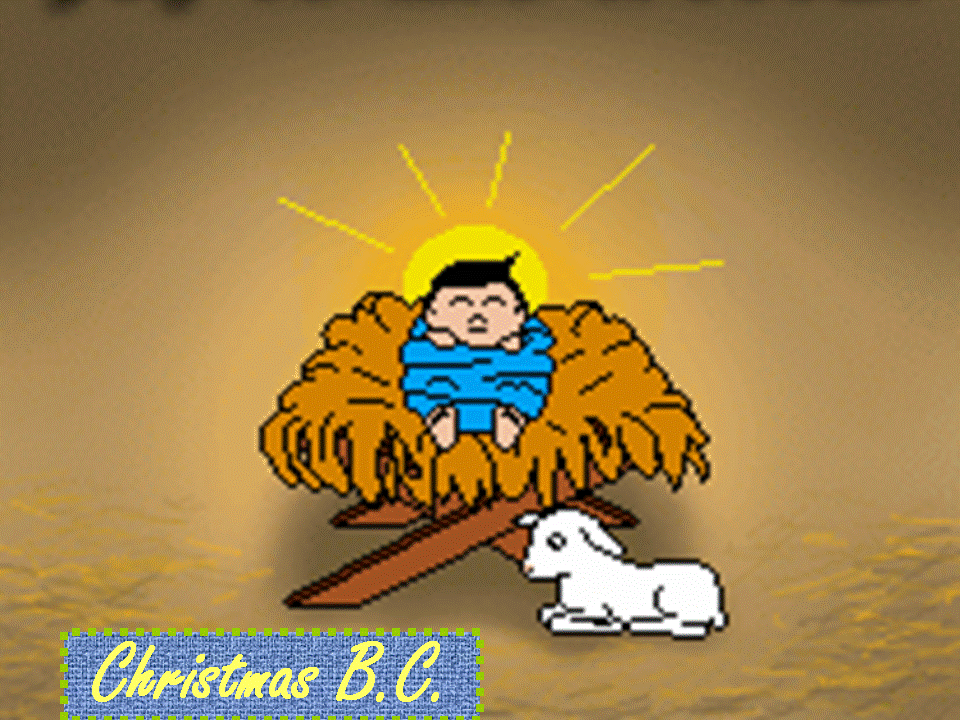
Were there sheep at the manger? We don’t know for sure, but I assume there
were since there were shepherds there. One thing is absolutely positive,
there was a Lamb there...and Mary’s little Lamb was the promised One Who
would wash us white as snow!
We’re going to focus on
Jesus as the Lamb slain before the foundation of the world. Even before God
began to construct creation, he made provision for the sins of a fallen
race. The Lamb is cradled in the womb of the Old Testament, whose types and
symbols, promises and prophecies are pregnant with the truths of Jesus.
The Lamb on the Mountain
We begin just a few chapters from where we started last week. If you have
your Bibles, please turn to Genesis 22. After nearly wiping out the
population during the flood, God calls Abraham to continue the righteous
seed of Eve in chapter 12. Abraham receives the promise that he will be made
into a great nation and that his descendants would be as numerous as the
stars in the sky and as many as the grains of sand on the seashore. God
eventually provides Sarah and Abraham with a son named Isaac in chapter 21
when Abraham was 100 years old!
Genesis 22 begins with God’s instructions for Abraham to take his son, the
son of promise to the mountain of Moriah. In verse 2, God tells him to
"sacrifice him there as a burnt offering..." Early the next morning, Abraham
set off to the mountain with his son. The journey took three days. I can’t
imagine what must have been going through his mind during this trip! Verse 6
tells us that Abraham took the wood for the burnt offering and placed it on
his son Isaac. In verse 7, young Isaac asks his dad a haunting question,
saying, The fire and wood are here, but where is the lamb for the burnt
offering? I love how Abraham answers his son in verse 8: God himself will
provide the lamb for the burnt offering, my son.
Abraham then builds the altar, arranges the wood and ties his only son to
the altar. As he reached out his hand to slay his cherished child, the angel
of the Lord speaks in verse 12: Do not lay a hand on the boy...do not do
anything to him. Now I know that you fear God, because you have not withheld
from me your son, your only son. Abraham then looks up and sees a ram that
is caught in the thicket. He then substituted the ram for his son and
sacrificed the ram in his place. From that point on, Abraham called that
place, "Jehovah-jireh," which means, "The Lord will provide."
Let me point out some truths from this passage:
1. Mount Moriah is where the Temple was eventually built. Scholars tell us
that it was in close proximity to where Jesus was crucified as the final
sacrifice.
2. God "himself" provided the lamb. The word "himself" is significant. God
"himself" sent his lamb to die for the sins of the world. The sacrifice came
from Him. It was no accident that the ram was in the thicket. God provided
the sacrifice. Just as Abraham offered his only son, so too, God himself
provided the sacrifice of His one and only son on our behalf. What’s more is
the wording in the original Hebrew – it could flow with the emphasis being
“God will provide HIMSELF [to be] a lamb. Isn’t that something?!
3. The ram was a substitute offering. Jesus died in our place, as our
substitute, when He paid the price for our sins. The ram points to the "Lamb
of God." Verse 8 shows us Abraham’s faith that God would provide a "lamb."
Verse 13 tells us it was a ram, which is a male sheep. Abraham’s statement
was really prophetic, foretelling a day when the Lamb of God would be
sacrificed on the altar of Calvary. The ram served as a substitute
sacrifice, but only the sinless, stainless Lamb of God can effectively wipe
out our sins once for all.
As we continue to sail through Scripture, I want to frame our study by
asking and answering Isaac’s question, "Where is the lamb?"
The Lamb in the Passover
For 400 years the Jews have lived in harsh, difficult conditions until God
raised up a leader named Moses. He goes before Pharaoh with a message from
God: "Let my people go!" Pharaoh blows him off, so Moses comes back several
times with the same refrain: "Let my people go!" But Pharaoh has no
intention of letting the Israelites go free.
So God devises a plan that will cause Pharaoh to beg the Jews to leave his
land. He sends a series of terrible judgments (called Plagues) on Egypt.
Although the first nine inflicted severe suffering upon the people, Pharaoh
hardened his heart against God. The tenth plague would get his attention. At
midnight on a certain night, the Lord would go through the land of Egypt and
every firstborn son would die immediately.
But God would spare the Israelites - if they followed His instructions. When
the blood of the lamb was sprinkled on the doorpost of each Jewish home, God
would see the blood and would literally "pass over" that house. But if God
didn’t see the blood, he would take the life of the firstborn in judgment.
It was the blood of the lamb that saved the people of God that night. Every
year since then, for 3500 years, the Jews have observed a Passover
celebration as a solemn reminder of God’s amazing deliverance in Egypt.
Here’s some notable similarities between the events of the first Passover
and the sacrifice of Jesus as our Passover Lamb.
1. It must be a lamb. Exodus 12:3 says that each man is to "take a lamb" for
his own household. It couldn’t be a bull or a dove, which were sometimes
used in other Old Testament sacrifices. God was very particular--it was to
be a lamb and only a lamb. Nothing else would do. In 1 Corinthians 5:7, Paul
refers to Christ as our "Passover Lamb, who has been sacrificed."
2. It must be a male. Exodus 12:5 states that "the animals you choose must
be males." Jesus fulfilled this in that he was the son born of the
Virgin Mary.
3. It must be a year-old lamb. Verse 5 continues by saying that the
lamb must be in its prime, neither too young nor too old. Jesus was in the
prime of his life when he died as our sacrifice on the cross.
4. It must be without blemish. The Hebrew text in verse 5 uses a phrase that
means "without defect." This means that the Jewish men would have to
carefully inspect their lambs to make sure there were no open sores, no
patches of bare skin, no infections, no diseases, no blotches or blemishes,
no sickness of any kind. This prevented a man from offering a lame or
inferior creature while keeping the best for himself.
1 Peter 1:19 speaks of Jesus Christ as being "a lamb without blemish or
spot." Hebrews 4:14-16 emphasizes that though Christ was tempted in every
way that we are, He was without sin. When Pontius Pilate finished examining
him, he declared in John 19:6, "I find no fault in him."
5. It must have no broken bones. Exodus 12:46 states that the Passover lambs
must have no broken bones. It was the custom of the Romans to break the legs
of those being crucified in order to hasten their death. John 19:32-36 tells
us that the Roman soldiers did not break Jesus’ legs because he was already
dead. Verse 36 points out that this happened to fulfill the Scripture that
says that not one of his bones will be broken. Although the verse that is
quoted is Psalm 34:20, the ultimate reference goes back to Exodus 12.
6. It must be offered "between the evenings." This unusual expression is the
literal translation of the Hebrew phrase found in Exodus 12:6. The words
literally mean "between the evenings," which in Jewish thought meant between
3-5 p.m.
The New Testament tells us that Jesus was nailed to the Cross at the "third
hour," meaning 9:00 a.m., since the Jews reckoned time in 24-hour periods
beginning at 6:00 a.m. Matthew 27:45 tells us that there was darkness from
the sixth hour until the ninth hour, or from 12 noon to 3:00 p.m. Shortly
thereafter Jesus uttered his final words and died. His body was then taken
down from the cross before sundown. Thus, Jesus died "between the evenings"
(3-5 p.m.) at the exact hour the Passover lambs were being sacrificed
throughout Israel.
7. The blood must be applied. Verse 7 states that after the lamb had been
slaughtered and the blood drained, the father was to put some of the blood
on the top and sides of the doorframe. The blood would be the sign that the
family had sacrificed a lamb as the Lord had commanded in verse 13: "The
blood will be a sign for you on the houses where you are; and when I see the
blood, I will pass over you. No destructive plague will touch you when I
strike Egypt."
The lamb alone could not save an Israelite. Not even a dead lamb could save.
Not even the blood in the basin could save. Only the blood sprinkled on the
doorpost could spare the people from the terrible judgment of God. The death
angel stopped at every home in Egypt, but every home in Goshen, where the
Israelites lived, was spared. From Pharaoh’s palace to the lowest household
came loud wailing and screaming. It was quite different for the Israelites.
Exodus 11:7 tells us that it was so quiet in their homes that not even a dog
barked.
Soon after that Pharaoh sent word that the Israelites were free to leave. In
fact he begged them to boogie before anyone else died in Exodus 12:33!
That’s why God told the Jews to eat the Passover in haste. He knew they
would be moving soon.
Jesus Christ is our only hope of salvation. He is God’s Lamb offered for the
sins of the world. However, Jesus’ blood saves only when it is applied to
our lives. For those who reject the blood, even the Lamb of God cannot save
them. If you want to experience freedom from bondage and avoid the sure
judgment of God, the Lamb’s blood must be applied over the door of your
heart.
The Lamb in Prophecy
Isaac’s question was, "Where is the Lamb?" The answer to that inquiry was
given in stages, as God’s redemptive history unfolded through the chapters
of Scripture. We now fast-forward to the prophet Isaiah to get a more
detailed description of the Lamb and a more complete answer to Isaac’s
question.
Please turn in your Bibles to Isaiah 53:4-5. There is no way to read this
passage and fail to see that the Lord’s Lamb is the great divine Substitute
for the evil of the human heart. What a beautiful picture of His work on the
Cross.
Drop down to verse 7: the silent Lamb
Once again, Scripture preserves carefully the sinlessness of Jesus. He was
without sin, but he bore the sins of others. That is why he did it in
silence. He had no interest in defending himself, so he never spoke up. He
was led to death as a Passover lamb. I’m told that when cows are about to be
slaughtered, they get real nervous and start bellowing. Sheep on the other
hand, are silent.
Writing over 500 years before Christ, Isaiah answers Isaac’s question of
"Where’s the Lamb?" by answering that the Lamb is the promised Messiah, the
suffering servant, who will be pierced for our transgressions and will be
our sin-bearer.
The Lamb in the Manger
Though lambs are not specifically mentioned in the Christmas story, they are
implied by the presence of the shepherds and by the fact that Jesus was born
in a place that was frequented by animals. Let’s look now at how Luke 2:8-20
sheds further light on Isaac’s question of where the Lamb is.
An angel gave the first announcement of the Messiah’s birth to some
anonymous shepherds. No one paid much attention to these guys who smelled
like sheep. They didn’t have refined social skills. They couldn’t bring
expensive gifts. They were regular guys who had a part in the greatest drama
in history.
Warren Wiersbe points out that it is quite possible that that these
shepherds were caring for the flocks that provided sacrifices for the temple
services. Imagine that if you will. Here we have men who are caring for
lambs who are being prepared to die in the temple. Then, the angel comes and
tells them the good news about the baby lamb who will one day take away the
sins of the world. The shepherds have spent their lives caring for lambs and
now they have the privilege of meeting the Lamb who will die in their place
and care for them for eternity.
When they heard the great news, verse 16 says that they hurried off and
found Mary and Joseph, and the baby, who was lying in the manger. They were
pumped! They didn’t waste any time. This is a good application for us.
Instead of being so busy running around this Christmas, let’s learn from the
shepherds and run to the lamb nestled in the straw. Let’s be in a hurry to
worship the Christ of Christmas who is both Lamb and Lord.
Once they saw the Lamb of God, verse 17 says that "they spread the word
concerning what had been told them about this child." They didn’t keep the
news to themselves. They told everyone they came in contact with about the
baby in the barn, lying in a feeding trough.
There’s no way of knowing whether they made the connection between Mary’s
little lamb and their sheep that were prepared for sacrifice. We don’t know
if they recognized the newborn boy as the ultimate Passover Lamb. What we do
know is that they went to check it out. The word "found" in verse 16 means
"found after a search." They didn’t just sit back and wonder. They were
moved to action. Friend, if you’ve never come face to face with the one who
exchanged His life for yours, would you run to the manger right now? We know
that things must have clicked for the shepherds when they got there because
verse 20 says that they returned glorifying and praising God for all the
things they had heard and seen, which were just as they had been told.
Lessons from the Lamb
1. Jesus Christ is God’s Lamb. He is the only person who meets all the
qualifications. He fulfills every detail of the Old Testament picture. No
other person in the Bible meets the requirements.
Later, after Jesus was born, Simeon took Him in his arms and blessed Him,
saying that Jesus would cause the rising and falling of many in Israel,
indicating that while some would follow him, others would bitterly oppose
Him. Then he added a special word for Mary in Luke 2:35: " a sword shall
pierce through thy own soul also."
This was an early reference to the kind of death Jesus would die. From the
very beginning he was marked out as God’s sacrificial lamb. He was born to
die! Although Mary did not know all the details, from the earliest days she
knew that suffering was his future. That’s why many of our greatest artists,
when painting Mary and the Christ child, have portrayed her with a sense of
sorrow and heaviness on her face, as if she can see the form of a cross on
the horizon.
Since the lamb must die in order for the blood to provide salvation, Jesus
must someday die and his blood must be shed. This is the fate and appointed
destiny of the Lamb of God who came to take away the sin of the world.
2. There is no salvation without sacrifice. Hebrews 9:22 reminds us that
"without the shedding of blood there is no remission." A living lamb may be
cute and cuddly, but it saves no one. Unless the lamb dies, his blood does
no good. In God’s economy, only shed blood can forgive sin. As the great
Lamb of God, Jesus had to go to the Cross in order to save the world.
Any shepherd will tell you that sheep have a "death wish." They do things
that put them in danger. He told me that he has to keep them from hurting
themselves and to protect them from dying. Friends, the Lamb of God came not
to come, but to die. He had a death wish. He was born not just to be born
and have us focus only on Christmas. He came to give His life a ransom for
many. He was the lamb of substitution. The babe in the manger was marked out
for Passover sacrifice. As a result, 1 Peter 1:19 declares that we are not
redeemed by perishable things...but with the precious blood of Christ, a
lamb without blemish or spot.
3. Even Jesus cannot save you without faith. Abraham had faith that God
would supply a substitute. In the Passover we learn that it is blood that
saves, when it is applied. Isaiah predicts how the Messiah would suffer and
die in our place. The Shepherds responded and then told others about the One
who can take away sins forever. Friends, attending GBC doesn’t save you.
When God looks down from heaven, the only thing that matters is that he sees
the blood of the Lamb applied to the doorposts of your heart.
4. When you know the Lamb, you’ll follow Him. Later, when Jesus was just
about to begin His public ministry, John the Baptist calls out to Him with
yet another part of the answer to Isaac’s question in John 1:29: “Behold,
the Lamb of God, who taketh away the sin of the world!" There can be no
doubt now. Jesus is the perfect fulfillment of the Old Testament pictures
and prophecies. He is the Passover Lamb who takes away the sin of the world.
John was so convinced of this that he said it again the very next day when
he saw Jesus in John 1:36: "Behold, the Lamb of God!" Verse 37 says that
when two men heard this proclamation, they decided to follow Jesus. Friend,
when you know the truth about the Lamb, you will follow Him!
It’s interesting that while Jesus is referred to as the Lamb of God, He is
also our shepherd and we are referred to as sheep. Isaiah 53:6 says, "All we
like sheep have gone astray."
More about sheep -- First, they are stupid. Do you know what is dumber than
a sheep?: "Two Sheep." I know I’m a lot like a dumb sheep. We all are.
Second, sheep are natural followers. You and I were created to follow the
Good Shepherd. Because we’re not too bright morally and spiritually, and
tend to go astray, we need to follow the Lamb who is also Lord.
5. If you refuse God’s Lamb, there is no other plan of salvation. Acts 4:12
puts it this way: "Neither is there salvation in any other, for there is
none other name given under heaven among men, whereby we must be saved."
Where’s the Lamb today?
The Book of Revelation refers to Jesus as the "Lamb" 30 different times. The
Lamb will one day return but first He had to die. And you must apply His
blood to the doorposts of your heart. That is, you must trust in the blood
for the forgiveness of your sins. Then you must follow Him.
Where will you find such a lamb? Look to the Cross! Gaze upon the bloody
body of the Son of God! Behold the Lamb of God, who takes away the sin of
the world! Jesus is the Lamb you need. He is God’s Lamb for your sin. He is
Mary’s Little Lamb...
Mary had the little Lamb, who lived before His birth;
Self-existent Son of God, from Heaven He came to Earth. (Micah 5:2)
Mary had the little Lamb; see Him in yonder stall-
Virgin-born Son of God, to save man from the Fall. (Isaiah 7:14)
Mary had the little Lamb, obedient Son of God;
Everywhere the Father led, His feet were sure to trod. (John 6:38)
Mary had the little Lamb, crucified on the tree
The rejected Son of God, He died to set men free. (1 Peter 1:18)
Mary had the little Lamb-men placed Him in the grave,
Thinking they were done with Him; to death He was no slave! (Matthew 28:6)
Mary had the little Lamb, ascended now is He;
All work on Earth is ended, our Advocate to be. (Hebrews 4:14-16)
Mary had the little Lamb-mystery to behold!
From the Lamb of Calvary, a Lion will unfold. (Revelation 5:5,6)
When the Day Star comes again, of this be very sure:
It won’t be Lamb-like silence, but with the Lion’s roar. (Psalm 2:12;
Revelation 19:11-16)
[from series by Brian Bill]
Help keep this service free by
recommending it using the voting links above the
sermon