|

Click the "Sermons" button for access to hundreds more messages and
PowerPoint Presentations!
 PowerPoint Viewer can be used to view our pps slideshow files if you
do not have PowerPoint.
PowerPoint Viewer can be used to view our pps slideshow files if you
do not have PowerPoint.
|
Streaming Audio:
Download
mp3
PowerPoint
Presentation:
Click
here after starting sermon audio to bring up slides and visual aides which go along with the sermon. [A new
window will open and remain blank until fully loaded. It may take 1-5
minutes to open.] Once the first slide appears you can follow along
with the message and use the arrow keys to advance the slides.
Help
RECOMMEND THIS
MINISTRY TO OTHERS:
Click here to
go to our feedback page at SermonCentral
[A new window will open. Scroll to the bottom to enter your comments, then close.]
Grace Notes Sermon Ministry:
Subscribe for free
Learn More
Go
to Gospel of Jesus Series Homepage
Heartburn
Luke 24:13-32
It was a walk to remember, but they had
forgotten Jesus’ promise of His resurrection, and even on the 3rd
day since His crucifixion, even with reports that the tomb was empty, they
still held no hope, it would be too good to be true...someone must have
stolen His body, they thought. This story shows how quick we are to give up
hope.
Paul wrote to his friends at Corinth,
1 Corinthians 15:19-20
19 If in this life only we have
hope in Christ, we are of all men most miserable.
20 But now is Christ risen from the
dead, and become the firstfruits of them that slept.
But on that first Easter day that living hope
was far from being established in the experience of the two people we read
of in our text. Let’s put ourselves in their shoes as they set out on the
seven-mile walk from Jerusalem to Emmaus. It was a:
A HEART-BREAKING EXPERIENCE
Have you ever noticed that some of the saddest words in our language begin
with the letter D? For example, discouragement, disappointment, doubt,
disillusionment, defeat, despair and death. All of these are summed up in
the words of Cleopas and his companion to the stranger who joined them on
the Emmaus road. They had left the dispirited and confused band of disciples
with the events of Friday fresh in their memories.
The Master they had revered, loved and followed had been horribly put to
death - a cruel death of the most degrading kind. Only a week before, on
Palm Sunday, the disciples’ hopes had risen to fever pitch when the excited
crowds had hailed their Master as the longed-for deliverer from the tyranny
of Roman occupation but now he lay dead in a sealed tomb! Their hopes were
dashed; the dream was over!
The band of Jesus’ followers was leaderless and was falling apart, with two
of them already on their way home. The reports that Christ’s tomb was empty
did nothing to alter their thinking; it only confused them. Their entire
world had come apart. The two despondent disciples summed up the situation
very neatly saying, "we had hoped that he was the one who was going to
redeem Israel." [their Messiah]
Human hope is a fragile thing, and when it withers it’s difficult to revive.
Hopelessness is a disease of the human spirit and it is desperately hard to
cure. When you see someone you love and care for overtaken by illness, which
goes on, and on, despair sets in. It almost becomes impossible to hope for
recovery, to be even afraid to hope because of not being able to cope with
another letdown.
The Emmaus Two had erected a wall of hopelessness around them, and they were
trapped in their misery. "We had hoped ..." What they were saying is "We
don’t expect it now, but once we did. We had it, this thing called hope, but
now it’s gone." I wonder if this is something that we can identify with. Has
something or someone come between our relationship with God? If so, listen
to the Emmaus story because the heart-breaking experience is only its
beginning!
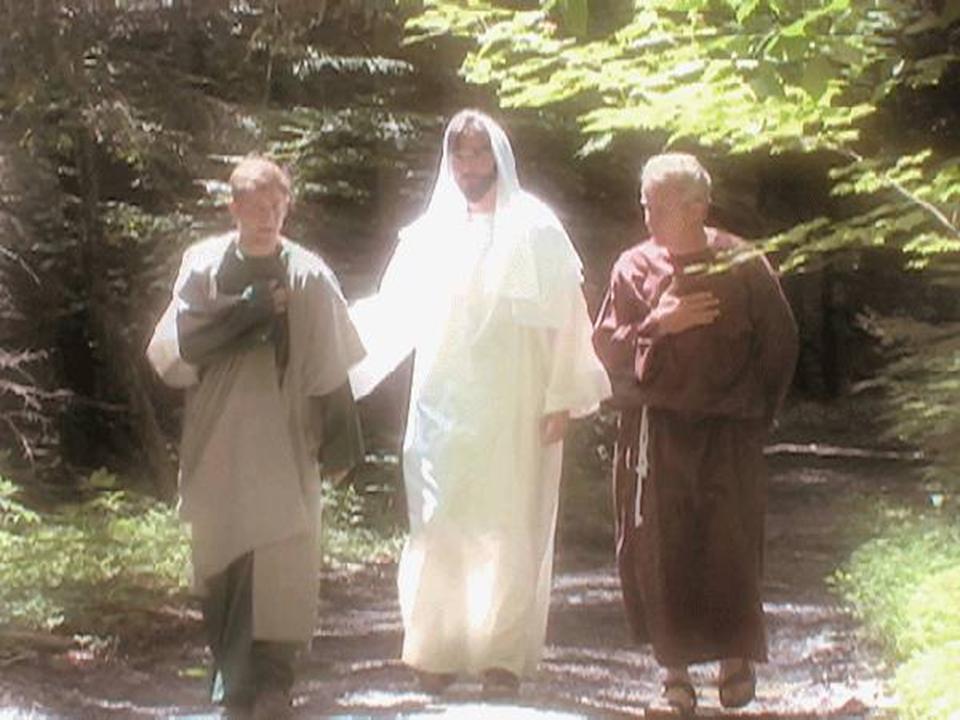
As the travelers made their weary way to Emmaus a stranger came alongside
them. It was going to turn into one of the most wonderful walks in history!
We know, of course, that it was the risen Jesus, but somehow they didn’t
recognize him. In fact Luke tells us they were kept from recognizing him. It
wasn’t an accident that they didn’t notice who he is or that they were too
preoccupied to look at him in the eye. No, they weren’t allowed to recognize
Jesus for a purpose. I believe it was so that they might be in the same
position as we are some 2,000 years later.
Visual appearances of Jesus ceased at his Ascension. They are not granted to
us. Like them we don’t know quite what to make of it. Did it really happen?
The stranger saw they were downtrodden and asked them, "What are you
discussing together as you walk along?" And so they poured out their sad
story to someone who seemed so willing to listen. How wonderfully kind and
compassionate is our Lord. He could well have chewed them out, to say the
least, for their lack of faith in him. Hadn’t he told them that unless a
seed dies, it abides alone, but if it dies it bears much fruit? (John
12:24). But no, Jesus doesn’t berate them, but rather, as someone put it in
moving words, "In his infinite courtesy, Jesus remembered the frailty of
over-strained nerves and bewildered minds and came, not too suddenly or
overwhelming upon them, but in a way which He alone could do, revealed
Himself as the Risen Christ."
The way that Jesus dealt with the situation is a lesson to all that are in a
position to help those who have lost hope. They need companionship. They
need a listening ear before a stream of good advice. The last thing they
need is a brisk "cheering up" talk or being told to "snap out of it".
Instead, let’s be there with them. Let’s love them by listening, by
accepting what it is that they feel. There’ll be time later to point them to
the way of hope, to the One in whom hope is to be found, but first things
first. It’s then that the heart-breaking experience changes to a:
A HEART-SEARCHING EXPERIENCE
Their spokesman, Cleopas, expressed surprise at even being asked what was
worrying them, "Are you the only one living in Jerusalem who doesn’t know
the things that have happened there in these days?"
The two Emmaus bound disciples were mostly correct in their theology as far
as it went. They told the stranger that this Jesus "was a prophet, powerful
in word and deed before God and all the people" (19). "He was ..." - notice
the use of the past tense, which strongly implies that he wasn’t relevant to
the present or otherwise they wouldn’t have been in their present downcast
state of mind. Their experience of Jesus was in the past, and they thought
they were alone. The Cross had taken him from them, and their minds hadn’t
made sense of the changed situation, or adjusted to it. The Cross was just a
great negative to them.
We’ve all heard exciting testimonies of what Jesus has done in the past -
but what about the present? The past is history. The question must be: is
Jesus "a present, bright reality" to those who give their experience, to you
and me? Do we always recognize him beside us? Life has many distractions -
hard work, routine, tiredness, ill health - which can so grind us down that
we become mechanical, never lifting our eyes - or minds - from the dust of
the earthly road we travel. We become unaware of the glory and strength of
his presence with us. Life loses its meaning and leaves us washed out, but
this story gives us hope.
Jesus is still there. He’s the unseen "stranger", walking with us, listening
to us and, if we are willing to hear his voice, revealing himself to us. As
the two disciples spoke of the Cross he took hold of their bewilderment and
sorrow and gave them a heart-warming experience. How did he do it? He
pointed them to God’s self-revelation in the Scriptures. Luke tells us, "And
beginning with Moses and all the Prophets, Jesus explained to them what was
said in all the Scriptures concerning himself."
Jesus must have given the Emmaus travelers the greatest Old Testament
exposition in history - to a congregation of two! It was then that the
jigsaw of the types, shadows and symbols of the Old Testament revelation
began to come together. He would have reminded them that right back at the
Fall of Mankind the apparently victorious Satan, in the form of the serpent,
was told that the seed, the offspring of the woman "will crush your head,
and you will bruise his heel" (Gen 3:15). What a wonderful anticipation of
Jesus at Calvary.
And so was foretold the story of the cosmic struggle between death and life,
of the pattern of death and resurrection in the Old Testament revelation.
It’s clearly visible in the life of Abraham, sacrificing his dear and only
son Isaac and getting him back again; of Joseph, preserved to become the
benefactor of his brothers who tried to destroy him; of the exodus of the
Israelites from Egypt after having been saved from the angel of death
through the sign of the blood of the Passover lamb.
Jesus would have recalled his own teaching of how the Israelites escaped
physical death in the wilderness from a plague of serpents when they looked
trustingly to a great bronze serpent which Moses raised on a pole, pointing
out that he too would be lifted up on the Cross, "that everyone who believes
in him may have eternal life in him" (John 3:15). Jesus would surely have
taken the now speechless disciples through the Suffering Servant of Jehovah
passages in Isaiah. He would have recounted how the nation of Israel, taken
into exile and brought back again to rebuild Jerusalem, was a symbol of the
greater redemption through personal salvation through faith in him.
Here was proof that Jesus had fulfilled that which had been prophesied over
the centuries; that these Old Testament anticipations of his passion and
triumph of life over death, proved that he was indeed the Messiah. The two
disciples couldn’t have expected that sharing their problem with the
stranger on the Emmaus road brought them towards a solution. But there was
more to it than that. Christ wasn’t there beside them simply to help them to
find solutions - he was in the problem itself. Jesus told his two listeners,
"Did not the Christ have to suffer these things ..." In other words, did He
die in vain? Was there no purpose to His life?
Cleopas and his companion accepted the gentle rebuke that Jesus made as He
said they were slow of heart to believe all that the prophets have spoken.
Perhaps the key word is "all". It wasn’t that they hadn’t read the OT, but
perhaps they’d read the Scriptures selectively, concentrating on those parts
that spoke of a triumphant Messiah who would be kind to his enemies and be
victorious. The passages that spoke of a suffering servant didn’t fit in
with their expectation of the Messiah and they’d tended to skip over them.
When they had been given the exposition from the Scriptures they reacted
positively, and in fact they wanted even more, which led them to:
A HEART-BURNING EXPERIENCE
Their two-hour journey from Jerusalem to Emmaus must have seemed like five
minutes, being so wrapped up in this absorbing conversation with the Lord
they hadn’t yet recognized. Luke informs us that as they approached the
village to which they were going, Jesus acted as if he was going further.
You see, Jesus is a gentleman; he won’t force himself if he’s not really
wanted. He awaited their invitation to come in.
God gave to the world the greatest and the most perilous gift in the world,
the gift of free will; and we can use it to invite Christ into our hearts or
allow him to pass on and knock on someone else’s door.
Revelation 3:20
Behold, I stand at the door, and knock: if any man hear my voice, and open
the door, I will come in to him, and will sup with him, and he with me.
This door...there’s no outer knob or handle to it. I expect there is a
handle...it’s on the inside! This is very much the situation in the Emmaus
story. It was a test to see if the disciples had more appetite for the
things of God. They did. We’re told that they urged Jesus strongly, ‘Stay
with us ...’ That’s the sort of invitation that Jesus can’t resist!
They needn’t have asked him in; he was ready to move on. But no, their
hearts had been won over. A basic meal was quickly got ready. The bread is
on the table and the moment for Jesus’ disclosure has come. How does he do
it? "He took bread, gave thanks, broke it and began to give it to them." It
was the action of the breaking of bread. They saw his hands - they were
different from when he had broken bread at the Feeding of the Five Thousand,
and at the Last Supper. They were the nail-pierced hands of Jesus. In an
instant they knew him. And in an instant, he’s gone...vanished out of their
sight!
Why did Jesus have to disappear? Couldn’t he have stayed longer? He could,
but he didn’t because it’s all part of the education of his last 40 days on
Earth - how to manage without his bodily presence from now on; exactly the
same as we have had to do for some 2,000 years now. But he is with us still
by his Spirit; he is with us as we fellowship with him in worship and, in
obedience to his command, as we remember him in the "breaking of bread"
communion service.
I can imagine Cleopas and his friend standing in amazement; perhaps
embracing in great joy, asking each other, "Were not our hearts burning
within us while he talked with us on the road and opened the Scriptures to
us?" Their world had come together again. That heart-burning experience is
something that we all need. We need it in a conversion experience when the
Spirit of God makes us realize that we need Jesus as our Savior and Lord. We
need it as we allow the Holy Spirit to apply the truths of Scripture in our
daily walk with Jesus.
Well, where are we in our experience? Are we still heart-breaking because we
need to meet the risen Christ? Perhaps we’re still in a heart-searching
process - if so, let it continue as it will surely lead to the heart-burning
experience we all need. God deeply longs for each one of us to walk with Him
in close fellowship so He can fulfill His plans for our lives.
The two disciples lost no time in retracing
their steps back to Jerusalem to share the Good News. May that be our
experience as we leave the Easter Season and continue walking our road.
[courtesy Owen Bourgaize]
Help keep this service free by
recommending it using the voting links above the
sermon |


